
The 300-hour service is not simply a bigger 100-hour service. It is the interval where the maintenance schedule meaningfully escalates – where two critical systems move from inspection to mandatory replacement, and where the cumulative effect of hours and thermal cycles on rubber and plastic components demands more than a visual check.
For most Yamaha 4-stroke models, the interval is 300 engine hours or 3 years, whichever comes first. Confirm the specific trigger for your engine in your owner's manual. That calendar trigger matters more than most boaters realize: if you're running 50 to 100 hours a season, you will hit three years well before 300 hours on the meter. The hour count alone is not the full picture.
This guide covers what actually changes at 300 hours, what carries forward unchanged from earlier services, and a few items commonly – and incorrectly – attributed to this interval that could add unnecessary work and expense if not clarified upfront.

What Actually Changes at 300 Hours
The 300-hour service builds on the 100-hour service and escalates three specific items. Everything else repeats unchanged from the 100-hour interval.
| Item | At 100 Hours | At 300 Hours |
|---|---|---|
| Water pump impeller | Inspect; replace if worn or at interval |
Full assembly replaced – impeller, housing, gaskets, O-rings, seals |
| Spark plugs | Inspect; replace only if needed | Replace all, regardless of appearance |
| Diaphragm fuel pump | Not on the schedule | Inspect for the first time |
| Internal anodes | Not typically on the schedule | Inspect (varies by model – check manual) |
| Engine oil & filter | Replace | Replace (unchanged) |
| Gear lube | Replace | Replace (unchanged) |
| Fuel filters | Replace | Replace (unchanged) |
| Timing belt | Inspect | Inspect (unchanged – not replaced) |
The key shift: what was inspection at 100 hours becomes replacement at 300 hours for the water pump and spark plugs. The diaphragm fuel pump enters the schedule for the first time. Everything else – oil and filter, gear lube, fuel filters, thermostat, anodes, timing belt inspection, throttle and shift linkage, grease points – carries forward from the 100-hour service and repeats unchanged.
The Complete 300-Hour Service Checklist
Use this as a reference. Always verify specific tasks and intervals against your engine's owner's manual – requirements can vary by model and model year.
| 300-Hour Service Checklist – Yamaha 4-Stroke Outboards | |
|---|---|
| ✓ Engine oil and filter – replace | ✓ All anodes – inspect, replace if 50%+ eroded |
| ✓ Gear lube – drain and refill, replace drain gaskets | ✓ Timing belt – inspect |
| ✓ Water pump full assembly – replace | ✓ Throttle and shift linkage – inspect and lubricate |
| ✓ Spark plugs – replace all | ✓ All grease fittings – lubricate |
| ✓ On-engine fuel filter – replace | ✓ Propeller – inspect, check shaft seal |
| ✓ Boat-mounted fuel/water separator – replace | ✓ Battery – inspect terminals and connections |
| ✓ Diaphragm fuel pump – inspect (new at 300 hrs) | ✓ Fuel lines – inspect for cracks or deterioration |
| ✓ Thermostat – inspect, replace as necessary | |

Water Pump Replacement: The Full Assembly, Not Just the Impeller
This is the headline item at 300 hours – and the one most commonly done incorrectly. At the 100-hour service, you inspect and possibly replace the rubber impeller. At 300 hours, the entire water pump assembly comes out: impeller, plastic housing, gaskets, O-rings, and seals.
The reason is mechanical, not arbitrary. The plastic housing wears alongside the impeller over hundreds of hours of operation. After 300 hours, the housing's interior walls develop scoring that a visual inspection will not always reveal. A new impeller running in a worn housing will not seal or flow correctly – which means reduced water delivery to the engine and a significantly shorter service life for the replacement impeller. Replacing only the impeller at 300 hours is a false economy.
| ⚠ Important |
|---|
|
Water pump kits are model-specific. Horsepower alone is not sufficient to determine the correct kit for your engine – search by your exact engine model to confirm the right assembly. If your engine recently ran hot, or if you find significant scoring in the housing during replacement, also inspect the wear plate. A scored wear plate should be replaced at the same time as the rest of the assembly. |

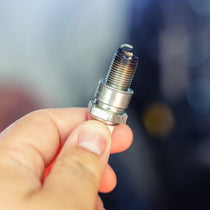
Spark Plugs: Replace All of Them
Every Yamaha 4-stroke outboard uses NGK spark plugs from the factory. The specific plug type, gap, and quantity vary by engine model and are not interchangeable across the lineup.
At 300 hours, all plugs are replaced regardless of appearance. A plug that looks serviceable may have worn internal components or subtle heat range changes that do not show visually. Since a full service is already underway, there is no good reason to leave used plugs in place for another 300 hours.
| ✓ Pro Tip |
|---|
| A model-specific 300-hour service kit from PartsVu will include the correct NGK plugs for your engine – no need to look up the specification separately or risk ordering the wrong heat range. |
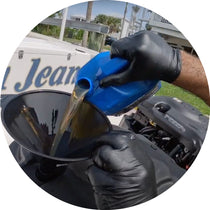
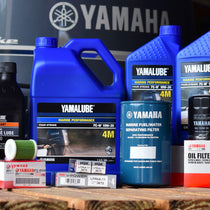
Engine Oil and Gear Lube: Getting the Right Yamalube Product
These items repeat from the 100-hour service unchanged – but the correct Yamalube product varies by engine model, and using the wrong product in the lower unit in particular can cause real damage.
Engine Oil
Yamaha specifies Yamalube 4M FC-W certified oil for all 4-stroke outboards. Three viscosity grades cover the lineup:
- 10W-30 – universal application across the 4-stroke lineup
- 20W-40 – warm-climate option approved for most models
- 5W-30 full synthetic – required for V MAX SHO models; recommended for peak performance across the range
Your owner's manual specifies which grades are approved for your engine. Oil capacity varies significantly across the lineup – verify your engine's capacity before ordering to ensure you have enough on hand. Replace the drain plug gasket at every oil change.

Gear Lube
Two Yamalube gear lube products cover the 4-stroke lineup, and they are not interchangeable:
- Yamalube Marine Gear Lube – for most standard 4-stroke models
- Yamalube Marine HD Gear Lube – required for higher-output and larger displacement models. Check your owner's manual if you are unsure which applies to your engine.
Each lower unit requires two drain gaskets at every gear lube change – one for the drain plug, one for the vent plug. They are single-use and should never be reused.

Fuel System Work at 300 Hours
The fuel system work at this interval is more limited than many sources suggest. Here is what is actually on the schedule:
- On-engine primary fuel filter – replace
- Boat-mounted 10-micron fuel/water separator – replace element (technically due every 50 hours; included as a carry-forward)
- Diaphragm fuel pump – inspect for the first time at this interval; replace if worn or damaged
- All fuel lines – visual inspection for cracking, stiffness, or deterioration
| NOTE |
|---|
|
Two fuel system items are commonly but incorrectly attributed to the 300-hour service: the VST (Vapor Separator Tank) filter and fuel injector service. Both are later-interval items. The VST filter is typically scheduled well beyond 300 hours. Fuel injector service is condition-based, not part of the standard 300-hour scope. If a shop recommends these items at your 300-hour service without a specific reason tied to your engine's symptoms or condition, it is worth asking why before authorizing the work. |
Timing Belt: Inspected at 300 Hours, Replaced Later
Most Yamaha 4-stroke outboards use timing belts, not timing chains. Yamaha's belts are Kevlar-impregnated and cogged for durability. At the 300-hour service, the timing belt is inspected – not replaced.
Replacement intervals vary by model, typically falling somewhere between 500 and 1,000 hours. Check your owner's manual for the correct schedule for your specific engine. When replacement does come due, the tensioner should be replaced at the same time. The 300-hour inspection is sometimes classified as a dealer-level task on Yamaha's official service schedule.
| ⚠ Important |
|---|
|
Most Yamaha 4-stroke outboards are interference engines. If the timing belt fails, pistons contact valves and the internal damage is severe and often irreparable. Stay ahead of the replacement interval specified in your owner's manual. Do not defer timing belt replacement based on how the belt looks – visual inspection alone does not reveal internal fatigue. |

Anodes: External and Internal
All anodes are inspected at every 100-hour service and replaced when roughly 50% eroded. The 300-hour service is no different in principle, but it is worth knowing that Yamaha outboards have more anodes than most boaters expect.
External anodes – the trim tab and any bracket or transom anodes – are the visible ones. Internal anodes are located in various places throughout the powerhead depending on your engine family. Your service manual identifies every location. Larger engines can have significantly more internal anode locations than smaller ones.

| ⚠ Important |
|---|
|
On many Yamaha models, internal anodes require new O-rings when they are removed. If those O-rings are not replaced and they fail, water enters the oil system – a serious and expensive consequence. Check your service manual and do not skip this step. If you are not comfortable with internal anode service on your specific model, this task is better delegated to a certified marine mechanic. |
What Is Not Part of the 300-Hour Service
A few items are consistently misattributed to this service interval. Knowing what does not belong at 300 hours protects against unnecessary work:
- Valve clearance inspection – the interval varies significantly by model. Check your owner's manual for your specific schedule. Yamaha 4-strokes generally hold valve clearance well over time.
- VST filter replacement – a later-interval item, typically well beyond 300 hours. Not part of the standard 300-hour scope.
- Timing belt replacement – inspected at 300 hours; replaced at a later interval that varies by model.
- Fuel injector service – condition-based, not part of the scheduled 300-hour scope unless a specific symptom or diagnostic result warrants it.
Frequently Asked Questions
How is the 300-hour service different from the 100-hour service?
The 300-hour service includes everything from the 100-hour service and escalates three items: the complete water pump assembly is replaced (not just inspected), all spark plugs are replaced regardless of condition, and the diaphragm fuel pump is inspected for the first time. Everything else – oil and filter, gear lube, fuel filters, anodes, timing belt inspection – repeats unchanged.
Is there a calendar equivalent if I don't hit 300 hours?
For most models, yes. Yamaha specifies 300 hours or 3 years, whichever comes first. Confirm the interval for your engine in your owner's manual. Recreational boaters averaging 50 to 100 hours per season will typically hit the 3-year calendar trigger before reaching 300 hours on the meter. Do not use the hour count as a reason to defer the service if the calendar says it is due.
Does the 300-hour service include timing belt replacement?
No. The timing belt is inspected at 300 hours but not replaced. Replacement intervals vary by model – often between 500 and 1,000 hours – so check your owner's manual for the correct schedule.
Why does the whole water pump assembly need replacing, not just the impeller?
The plastic housing wears alongside the impeller over hundreds of hours. A new impeller in a worn housing will not seal or flow correctly, which reduces cooling effectiveness and shortens the service life of the new impeller. Replacing the full assembly – housing, gaskets, O-rings, and seals – is the correct approach at 300 hours.
Can I do the 300-hour service myself?
Most of it, yes – oil, gear lube, spark plugs, fuel filters, and external anodes are all DIY-friendly with the correct tools and service manual. Timing belt inspection is sometimes classified as a dealer-level task by Yamaha, as is internal anode work on many models (which requires O-ring replacement). If your engine is under warranty, confirm with your dealer before proceeding with DIY service.
What is the difference between standard and HD gear lube for Yamaha outboards?
Yamaha offers two gear lube products for 4-stroke outboards: standard Yamalube Marine Gear Lube for most models, and Yamalube Marine HD Gear Lube for higher-output and larger displacement models. Using the wrong product can damage the lower unit. Check your owner's manual to confirm which applies to your specific engine.
What happens if I skip the 300-hour service?
The most significant risk is leaving a worn water pump assembly in service – which means reduced cooling protection across the next 300 hours. Worn spark plugs reduce combustion efficiency and can cause misfires. And the diaphragm fuel pump goes another full service interval without any inspection. None of these failures announce themselves early. By the time a symptom appears, the damage is typically already accumulated.
My engine was recently serviced but I don't have records – how do I know if the 300-hour service was done?
Inspect the water pump housing: a housing that has been recently replaced will show no scoring on the interior walls and will have fresh O-rings and seals. Check the spark plugs for a new appearance and confirm the correct NGK plug type for your engine is installed. If records are genuinely unavailable, the most reliable approach is to treat the 300-hour service as due and perform it – the parts involved are maintenance items, not expensive repairs.
The 300-Hour Service Done Right
The 300-hour service is straightforward when you have the right parts and understand exactly what changes at this interval. The water pump assembly, spark plugs, fluids, and filters are all model-specific – what fits an F150 will not necessarily fit an F250. Getting the correct kit for your engine eliminates guesswork and ensures the job is complete.
Use the service as an opportunity to confirm the engine's overall condition, not just complete the checklist. Check the timing belt visually while it is accessible. Note anything that looks marginal. A 300-hour service done thoroughly sets the engine up well for the next major milestone.