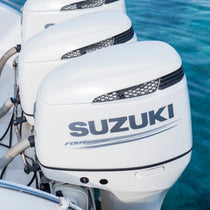

A Suzuki outboard that refuses to start tends to provoke one of two reactions: panic, or a long string of words that shouldn’t be repeated. Neither helps. What does help is working through the problem methodically – ruling things out in the right order and resisting the urge to start swapping parts before you know what’s actually wrong.
Most no-start situations on Suzuki outboards are not catastrophic. The bigger problem is usually figuring out which small problem you’re actually dealing with. This guide walks you through it – from the things that take seconds to check, through fuel and ignition diagnostics, and finally to the issues that belong with a dealer.
Engine coverage: This guide centers on Suzuki’s four-stroke DF lineup, which has been the company’s primary offering for years. Most advice also applies to older two-stroke DT models, with differences noted where they matter.
|
Important: Suzuki’s outboard lineup spans decades and dozens of models. Fuse locations, wire colors, connector types, and diagnostic steps vary between generations. Always pull the manual for your specific engine before unplugging anything or putting a meter on a circuit. |

Start by Listening: What Your Engine Is Telling You
What the engine does when you turn the key is the single most useful piece of information you have. It immediately splits the problem into two buckets:
- Silence, a click, or a warning beep – the starter isn’t turning the engine over. The problem is electrical: battery, connection, fuse, safety switch, or the starter itself.
- Cranks normally but won’t fire – the starter is doing its job. The engine isn’t getting fuel, spark, or both.
If you’re not sure which category you’re in, the one-minute checks below will tell you.
Symptom Reference Table
Use this table to identify the most likely starting point for your specific symptom. Many no-start scenarios share causes – start with the most likely column, then work right if it doesn’t pan out.
| What you’re seeing / hearing | Most likely cause | Also check |
|---|---|---|
| No sound at all when key turns | Battery dead or no power to ignition | Fuses • ignition switch • main relay |
| Single click, no crank | Weak battery or bad connection | Starter solenoid • starter motor |
| Repeated beep on key-on, no start | ECM fault code / engine warning | Check beep pattern in owner’s manual |
| Cranks normally, won’t fire | Fuel delivery or spark issue | Fuel quality • filter • spark plugs |
| Cranks, almost fires, then dies | Fuel delivery (flow restriction) | Water in fuel • clogged filter • fuel pump |
| Suzuki outboard starts then dies | Fuel starvation or idle circuit | Tank vent • carb / injectors • fuel pump |
| Strong fuel smell, plugs wet | Flooded engine | Clear flood, check plugs, restart |
| Ran fine in fall, won’t start in spring | Old / degraded fuel | Battery • water in fuel • gummed carb |
| No power to gauges or ignition at all | Main fuse or battery disconnect | Kill switch wiring • corroded harness plug |

The One-Minute Checks (Do These First)
An embarrassing percentage of no-start situations resolve right here. Before reaching for a multimeter or pulling the cowling:
1. Kill switch / lanyard – The red lanyard clip must be firmly seated with no gap. If it’s been pulled, sitting loose, or gone missing, the engine will refuse to start with no other clue. Reseat it and try again.
2. Shifter fully in neutral – Suzuki engines have a neutral safety interlock. The shifter must be all the way in the neutral detent – not close, all the way. Wiggle it slightly to confirm it’s seated.
3. Fuel in the tank – Verify the level itself, not the gauge. Gauges fail. On portable tanks, confirm the vent on the cap is open – a closed vent creates a vacuum and shuts off fuel flow entirely.
4. Primer bulb firm (if equipped) – Squeeze until hard. If it never firms, you have an air leak, a blocked pickup, or no fuel reaching the bulb. If it firms quickly and stays firm, fuel is reaching the engine.
5. Fuel line intact – Check quick-connects at both ends. Run your eye along the line for kinks, cracks, chafing, or anywhere it’s been pinched.
If all of these check out and the engine still won’t start, you’ve at least cleared the easy end. Now the diagnosis gets more systematic.
Suzuki Outboard Starter Problems: Electrical Diagnosis
Silence on key-on, a lone click, beeps with no cranking, or no power to the ignition at all – these point at the electrical side. The starter needs a healthy battery, a solid current path, and a valid start signal through the safety circuits. Any break in either chain and the engine sits there.
Battery
A multimeter reading at rest tells you part of the story, but a battery that reads acceptable voltage can still fail under cranking load. The most reliable check is a load test – most marine shops will do one in a few minutes. Lead-acid, AGM, and lithium batteries all behave differently; use your battery’s documentation for the correct voltage and load thresholds, not generic numbers.
A fully charged 12V lead-acid battery reads around 12.6V at rest. Below 12.4V suggests a problem; below 12.0V means it’s likely not going to crank reliably. AGM batteries hold voltage differently – confirm with your battery’s spec sheet.
Terminals and Cables
Visible corrosion on battery posts – white or green crystalline buildup – is enough to disrupt cranking current even when the battery itself is healthy. Disconnect (negative first), clean posts with a wire brush, neutralize heavy buildup with baking soda paste, rinse, dry, and reconnect with proper torque. Then follow the heavy positive and negative cables to the engine and inspect their full length for damaged insulation, loose connectors, and especially a ground strap that’s worked loose at the engine block. A poor ground mimics a dead battery convincingly.
Fuses
Fuses on Suzuki outboards are located inside the cowling – the exact location varies by model, so check your manual. Pull and visually inspect each one; a blown fuse can look intact at a casual glance, especially smaller ones. Hold them up to light or verify continuity with a meter. A blown main fuse is one of the most common causes of complete loss of power to the ignition.
Saltwater Corrosion
If the boat runs in salt, every electrical connection on the engine is a candidate for trouble. Salt builds resistance in plugs, terminals, and fuse holders for years before anything fails visibly – the first sign is usually a starter that cranks a little slower than it used to, then one morning it doesn’t crank at all. Check harness plugs, fuse holders, the main power lug, ground straps, and kill switch wiring. Signs: green or white crusty buildup, puffed insulation around a connector, plugs that fight when you separate them. Clean with electrical contact cleaner, pack with dielectric grease, and reassemble.
[ IMAGE PLACEHOLDER ]
ECM Self-Check and Warning Beeps
On fuel-injected DF Suzukis, turning the key to On (without cranking) triggers a self-check. You should hear the fuel pump prime for a couple of seconds and a beep as the ECM completes its check. If neither happens, the ECM may not be powering up – pointing to a fuse, relay, bad ground, ignition switch issue, or upstream wiring fault, not the engine itself.
If you hear beeps when you turn the key: The ECM is flagging a specific fault. Beep patterns correspond to different fault types; continuing to crank past a warning is rarely productive. Look up the pattern in your owner’s manual, or have a Suzuki dealer retrieve the stored codes.
Ignition Switch
A worn or corroded ignition switch is an often-overlooked cause of suzuki outboard no power to ignition symptoms – especially on older engines or boats in harsh environments. If the battery, fuses, and wiring all check out but there’s still no power at the ignition, the switch itself may not be completing the circuit reliably. Test by checking for voltage at the switch output with the key in the On position.

Suzuki Outboard Cranks But Won’t Start: Fuel System
If the starter is spinning the engine over normally and it simply won’t catch, the problem has narrowed to fuel or spark. Fuel is faster to verify, so start there.
Old or Degraded Fuel
Ethanol-blended gasoline can begin degrading within 30–90 days under poor storage conditions – warm, humid environments accelerate breakdown significantly. Old fuel from last season is one of the top causes of post-storage Suzuki outboard starting problems. Ethanol also pulls moisture from the air while sitting, creating water contamination in the tank.
If the boat has been parked since fall, assume the fuel is part of the problem until you’ve ruled it out. The fix: drain the old fuel, refill with fresh, and add a marine-rated stabilizer so this doesn’t repeat. There’s no shortcut here.
Water in the Fuel
Open the water-separating fuel filter and check the bowl. A small amount of water is normal accumulation – that’s the filter doing its job and it gets drained at service. A significant amount means contamination in the tank itself; the tank will need to be drained before the engine will run reliably.
Fuel Flow Restriction
If the primer bulb collapses during cranking, or the engine fires briefly and then dies, fuel isn’t flowing freely. The water-separating filter is a routine maintenance item – replace it on the schedule in your manual, or immediately if you can’t remember the last service. Also check the anti-siphon valve if equipped; these can stick closed and choke off supply entirely.
Reading the primer bulb: Bulb won’t get firm – problem is upstream (tank vent, pickup tube, anti-siphon valve). Bulb firms but engine still won’t start – problem is downstream (filter, fuel pump, injectors or carb).
Fuel Pump
On fuel-injected Suzukis, turning the key to On should produce audible pump activity – a brief hum or whirr as the pump primes the rail. Total silence at the pump suggests a blown fuse, a failed relay, or the pump itself. Confirming pump pressure requires a gauge and the specification from your service manual for your engine.
Flooded Engine
Crank a stubborn engine long enough and you can flood it – raw fuel pooled in the cylinders where it doesn’t belong. You’ll smell it, and plugs will come out soaked. Standard recovery: pull all plugs, push the throttle to wide open, crank for a few seconds to blow out excess fuel, wipe or replace plugs, return throttle to normal start position, and try again. On EFI models, check your owner’s manual – some Suzuki DF engines have a specific flooded-start procedure that accounts for ECU fuel delivery logic. Don’t just keep cranking; you’re washing oil off the cylinder walls.
Carburetor (Older and Small-Displacement Models)
Carbureted Suzuki engines – older DT two-strokes and small portable four-strokes – need a manual choke or primer for cold starts. After extended storage, varnish from degraded fuel can block jets and passages enough to prevent starting even with fresh fuel. Carb cleaning is a DIY-friendly job with the right rebuild kit, but pay close attention to jet sizes – mixing jets between carburetors on multi-carb engines causes its own problems. Fuel-injected DF models do not have a choke; the ECM enriches the mixture automatically.

No Spark: Confirming Ignition on a Suzuki Outboard
When fuel checks out and the engine still won’t fire, the answer is almost always in the ignition system. On a stubborn no-start that’s survived everything above, this is frequently where the problem turns up.
How to Test for Spark
Pull one plug and reconnect it to its wire. Hold the threaded body firmly against bare metal on the engine block – not the cowling, which doesn’t provide a reliable ground – and have someone crank the engine while you watch the gap. A healthy spark is vigorous, blue-white, and consistent across crank pulses. A weak yellow spark, intermittent spark, or no spark at all is an ignition problem.
What the Plug Tells You
- Tan or light gray electrode – running correctly.
- Black, sooty deposits – rich running or oil fouling.
- Wet with fuel – engine is flooded; clear it before continuing.
- Oily deposits – oil reaching the combustion chamber, a separate issue worth investigating.
- Cracked porcelain or burned electrodes – plug is finished; replace it.
Always use the exact Suzuki-specified plug – heat range and gap both matter. The wrong plug creates its own no-start issues on top of the one you’re trying to solve.
No Spark on One Cylinder
Missing spark on a single cylinder typically points to that cylinder’s ignition coil, but can also be the plug wire, an injector issue (on EFI engines), or wiring to that cylinder. Confirm with a multimeter and the wiring diagram for your engine.
No Spark on Any Cylinder
No spark across all cylinders is a broader problem. Possibilities include a failed ignition module, the kill switch circuit shorted to ground, a stator issue, or – on older two-stroke DT engines – a failed power pack. Tracking the exact cause requires a multimeter and your engine’s specific wiring diagram. This is the appropriate point to hand it off to a technician if electrical diagnosis isn’t your comfort zone.
Using Onboard Diagnostics: ECM Fault Codes
Modern Suzuki four-strokes record fault codes whenever sensors detect something out of range. Many owners never check them. If you have a compatible Suzuki gauge or a NMEA 2000 display capable of reading engine data, fault codes may be visible right at the helm.
The ignition self-check (key to On before cranking) runs a sweep of all monitored systems. Anything flagged – or anything stored from a previous run – appears on the gauge or sits in memory for a technician to retrieve.
|
Important caveat: Fault codes are diagnostic clues, not always the definitive answer. A sensor code doesn’t automatically mean the sensor failed – it can mean the wiring to that sensor is corroded, or a related component is reading out of range and the sensor is reporting correctly. Codes point you toward where to look, not always what to replace. |
[ IMAGE PLACEHOLDER ]
Suzuki Outboard Starts Then Dies: Specific Scenarios
An engine that fires and then immediately dies – or runs for a few seconds before stalling – is a distinct pattern from a hard no-start. Common causes:
- Tank vent closed – engine draws fuel until it creates a vacuum in the tank, then stalls. Open the vent and try again.
- Fuel starvation – primer bulb collapses, clogged filter, weak fuel pump, or anti-siphon valve partially stuck. Engine gets enough fuel to fire but not enough to keep running.
- Idle circuit issues (carbureted engines) – varnish in the idle jet or pilot circuit. Engine catches on the main circuit but dies when it falls to idle.
- Water contamination – engine fires on the fuel in the line, then ingests water from the bowl and dies.
- ECM fault / sensor problem – the ECM may command a shutdown if a sensor – coolant temp, oil pressure, or MAP – reads out of range during startup.
- Neutral safety issue – shifter not fully in neutral; engine fires but the safety circuit interrupts and kills it.
When It’s Something More Serious
If you’ve worked through fuel, spark, battery, and safety circuits and the engine still won’t start, the problem is likely mechanical or requires dealer-level diagnostics:
- Compression loss – broken piston ring, burned valve, or blown head gasket can leave a cylinder unable to fire. A compression test requires a gauge and all plugs removed. The key number is consistency between cylinders; significant variation between cylinders is the warning sign.
- Timing belt or chain failure – Suzuki four-strokes use a timing belt or chain depending on model. A jumped or broken belt produces a hard no-start and can cause internal engine damage. Don’t keep cranking – this is not DIY territory.
- Starter motor or solenoid failure – a loud click with no cranking on a verified-good battery with clean cables points here. Either can fail outright or develop intermittent faults before going permanently.
When to Call a Suzuki Dealer
DIY troubleshooting has practical limits. There’s a clear point where a dealer with factory diagnostic equipment is the better investment:
- You’ve exhausted the obvious – fuel, battery, spark, and safety circuits all check out, engine still won’t start.
- Fault codes you can’t interpret – beep patterns or gauge codes that don’t match anything in your manual.
- ECM, ignition module, or sensor diagnosis – these almost always require factory software before any parts get replaced.
- Timing belt or internal engine work – few owners are equipped for these, and the consequences of doing them wrong are expensive.
- Warranty in play – certain DIY work can affect Suzuki’s warranty coverage. Check before you start.
When you hand it off: Write down everything you’ve already checked and exactly when and how the no-start happens. A clear, organized handoff saves hours of duplicated diagnostic time.
How to Prevent Suzuki Outboard Starting Problems
The majority of no-start situations trace back to a small number of preventable causes:
- Stabilize fuel before storage – don’t leave the boat sitting for months on untreated fuel. Marine-rated stabilizer is inexpensive and effective.
- Service the water-separating filter on schedule – cheaper than a tow.
- Replace spark plugs at the recommended interval – inspect them whenever the cowling comes off for another reason.
- Maintain the battery – a maintainer through the off-season and an annual load test catches most battery no-starts before they happen at the ramp.
- Flush after every saltwater outing – apply dielectric grease to any electrical connection you’ve disturbed.
- Follow break-in procedures on new engines – Suzuki specifies a 10-hour break-in period for new DF engines, with progressive throttle increases. Proper break-in affects long-term reliability and hard-start symptoms can develop on engines that weren’t broken in correctly.
- Annual service by a Suzuki technician – most no-start situations are easier to catch during routine service than at the dock.
At-the-Dock Pocket Checklist
Work this list in order when the engine won’t start:
| Check | What to look for |
|---|---|
| ☐ Kill switch lanyard | Firmly seated, no gap |
| ☐ Shifter position | All the way in neutral detent |
| ☐ Fuel level | Verify at tank, not gauge |
| ☐ Tank vent | Open on portable tanks |
| ☐ Primer bulb | Firms up and stays firm |
| ☐ Fuel quality | Fresh, no off smell or color |
| ☐ Fuel filter bowl | No water, clear or light amber |
| ☐ Battery voltage | 12.4V+ at rest, load-tested |
| ☐ Terminals and cables | Clean, tight, no corrosion |
| ☐ Fuses | All intact (visual + meter) |
| ☐ ECM self-check | Pump primes + beep on key-on |
| ☐ Spark test | Blue, vigorous, consistent |
| ☐ Plug condition | Tan/gray, no fouling, correct gap |
| ☐ Fault codes | No warnings on gauge display |
Just about every no-start on a Suzuki comes back to one of three things: power, fuel, or spark. Work through them in that order. Most problems show themselves within the first few minutes of looking. Where people get into trouble is skipping ahead – replacing plugs before checking the battery, or pulling the fuel filter when the real culprit was a lanyard sitting half-clipped.
If you’ve cleared all three and the engine is still dead, you’ve reached the point where more driveway time isn’t going to help. Don’t start throwing parts at it. Write down what you’ve already checked, hand it off to a Suzuki-experienced technician, and let the right diagnostic tools do the work.
With a methodical approach, the gap between “won’t start” and “running fine” is usually a lot shorter than it feels at the ramp.

Frequently Asked Questions
Why won’t my Suzuki outboard start after winter storage?
Old fuel is almost always the first suspect after a long sit. Ethanol-blended gas can begin degrading within 30–90 days, leaving gum and varnish in the carb or injectors and pulling moisture from the air the entire time it sits. Right behind it is the battery – a battery ignored all winter often won’t hold up under cranking load even if it reads decent voltage. Drain the old fuel, refill with fresh, add a marine-rated stabilizer, and have the battery load-tested before chasing anything else.
Why does my Suzuki outboard crank but won’t start?
Cranking confirms the battery and starter are working. The remaining suspects are fuel and spark. Start with the basics: kill switch, neutral, fuel level, primer bulb. Move to fuel delivery (filter condition, water in the bowl, pump priming sound on key-on) before testing for spark. A proper spark test means pulling a plug, grounding it to the engine block, and watching for a strong blue spark while someone cranks the engine.
Why does my Suzuki outboard start and then immediately die?
An engine that fires and then dies points to fuel starvation or an ECM shutdown. Check the tank vent first – a closed vent creates a vacuum that kills fuel flow once the engine draws down the line. Then check the fuel filter and primer bulb behavior during cranking. On EFI engines, an ECM fault (oil pressure, coolant temp, or another sensor reading out of range at startup) can trigger an immediate shutdown; check for beep patterns or gauge fault codes.
What do the beeps mean when I turn the key on?
Beeps on key-on are the ECM’s diagnostic warnings. The beep pattern indicates the type of fault – anything from low oil pressure to sensor failures to conditions serious enough that the engine refuses to run. Don’t keep cranking past a warning beep. Look up the specific pattern in your owner’s manual, or have a Suzuki dealer pull the stored codes with factory diagnostic software.
Why is there no power to my Suzuki outboard ignition?
Complete loss of power to the ignition – no gauges, no self-check, nothing – usually means a blown main fuse, a disconnected battery terminal, or a failed ignition switch. Start with the battery and terminals, then locate and inspect all fuses inside the cowling per your manual. If battery and fuses are good, test for voltage at the ignition switch output with the key in the On position. On saltwater boats, heavily corroded harness plugs or fuse holders are a frequent culprit.
Can I jump-start a Suzuki outboard?
Yes, with proper technique. Use a known-good 12V source and clean cables. Connect positive to positive first, then negative to a clean ground point on the engine block rather than directly to the dead battery’s negative terminal. Allow the engine to run afterward to recharge. If the engine doesn’t respond to a jump at all, the issue goes beyond a discharged battery and other items in this guide need investigation.
Why does my Suzuki four-stroke outboard start cold but not warm?
Heat-related no-start symptoms are a classic ignition sign – coils, ignition modules, and stators can function when cold but fail once they reach operating temperature. It can also be fuel-related: vapor lock occurs in hot conditions when fuel in the line vaporizes and blocks flow. Note exactly how long the engine runs and how long it needs to cool before it’ll restart – that pattern is your most useful diagnostic clue for a technician.
Should I troubleshoot a Suzuki outboard myself or take it to a dealer?
Kill switch, neutral interlock, fuel quality, battery, fuses, fuel filter, spark plug inspection, and basic primer bulb checks are all solid DIY work and resolve most Suzuki outboard starting problems. Once you’re into fault code interpretation, ECM or ignition module testing, injector diagnosis, or internal engine work, a Suzuki-experienced marine technician with the right tools will save you time and money compared to guessing.
| Always consult your specific Suzuki owner’s manual or factory service literature for model-specific procedures, torque specifications, fuse locations, and part numbers. The guidance above covers the broad strokes for Suzuki’s DF series four-stroke outboards and most other Suzuki marine engines, but specific details vary by model and year of manufacture. |