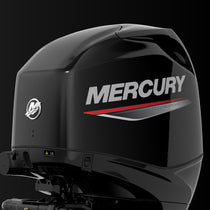

Finding the right Mercury outboard parts doesn't have to be complicated—if you know where to start. Whether you’re maintaining a classic 2-stroke or running a modern 4-stroke, getting the right components keeps your engine reliable and performing at its best.
Start With Your Serial Number
Before you buy anything, locate your Mercury engine’s serial number. This number is your blueprint. Mercury uses it to identify the exact specs of your outboard—model year, horsepower, and internal systems. You’ll usually find the serial number on a plate mounted on the transom bracket or the engine block.
Once you you have your engine model and serial number, visit PartsVu’s "Shop by Engine" tool. This feature filters out incompatible parts and shows you exactly what fits your motor. It’s the fastest way to eliminate guesswork.

Know the Common Mercury Outboard Parts
Here are the most common parts boat owners need to replace or upgrade, plus the warning signs they’re failing:
-
Water pumps and impellers – Crucial for cooling your engine.
Warning sign: Overheating or weak water stream at idle.
-
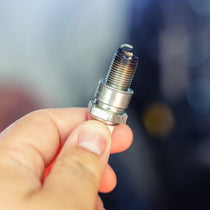
Spark plugs – Small but essential.
Warning sign: Rough idle, poor fuel economy, hard starting.
-
Fuel filters – Keep debris and moisture out of your engine.
Warning sign: Engine bogs under throttle or won’t start at all.
-
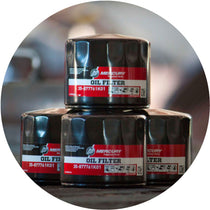
Oil and oil filters – Mercury 4-strokes require regular oil changes.
Warning sign: Dirty oil, noisy operation, drop in performance.
-
Propellers – A dinged or mismatched prop robs you of speed and fuel efficiency.
Warning sign: Slow holeshot, poor top-end speed, vibration.
-
Anodes – Protect your motor from corrosion.
Warning sign: Visible pitting or erosion. If they’re more than 50% gone, replace them.
-
Thermostats, gaskets, belts, and sensors – Small components, big problems if ignored.
Warning sign: Irregular temperatures, oil leaks, or warning lights.
Use Service Kits for Simplicity
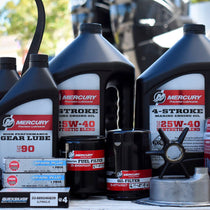
Instead of buying every part individually, grab a Mercury Service Kit. These kits include all the routine maintenance items you need for your specific engine model.
Example: Mercury 115 HP 4-Stroke (100-Hour Kit)
-
OEM oil filter
-
5 quarts of SAE 10W-30 FC-W marine oil
-
Fuel/water separating filter
-
Drain plug gasket
-
Set of spark plugs
-
Lower unit gear lube
-
Gear lube pump
-
Detailed service checklist
Service kits save time, money, and frustration. They ensure everything fits and meets Mercury's factory specs.

OEM vs. Aftermarket: What’s the Difference?
Fitment: OEM parts are guaranteed to fit exactly since they’re built to Yamaha's specifications. Aftermarket parts can vary in fit depending on the brand.
Warranty Impact: Using OEM parts keeps your Mercury warranty intact. Aftermarket parts may void the warranty if a related failure occurs.
Long-term Reliability: OEM parts are designed specifically for the marine environment, offering proven durability. Aftermarket quality ranges—some brands are excellent, others may not hold up over time.
Cost: OEM parts typically cost more upfront. Aftermarket parts are often cheaper but may come with a shorter lifespan or inconsistent performance.
Trust Factor: OEM components are built and tested by Mercury. Aftermarket parts require more brand research to ensure quality and compatibility.
If you’re not sure, stick with OEM or trusted aftermarket brands from PartsVu.
Where to Buy the Right Parts
PartsVu.com simplifies the process with tools built for Mercury owners:
-
✅ Shop by Engine – Just enter your serial number and see only the parts that fit
-
✅ Service Kits – All-in-one maintenance packs tailored to your model
-
✅ Oil Change Kits – Everything you need for a clean, correct oil change
PartsVu specializes in Mercury outboard parts and ships quickly, so you can get back on the water without delay.

Troubleshooting Common Problems
Many common Mercury outboard issues trace back to worn or neglected parts. Here’s what to look for—and how the right replacement parts can fix it.
-
Engine bogs when accelerating
Cause: Clogged fuel filter or fouled spark plugs
Fix: Replace both using a service kit
-
Overheating at idle or high RPMs
Cause: Worn water pump impeller or faulty thermostat
Fix: Install a new impeller and thermostat matched to your serial number
-
Shifting is stiff or inconsistent
Cause: Stretched control cables or low gear oil
Fix: Replace cables or change lower unit oil using the correct kit
Frequently Asked Questions
How often should I service my Mercury outboard?
Mercury recommends a full service every 100 hours or once per season, whichever comes first. That includes changing the oil, replacing filters, inspecting the water pump, and checking the fuel system. Using a service kit makes this process much faster and mistake-free.
Can I mix aftermarket and OEM parts?
You can, but it’s not always smart. Mixing parts may create fit issues or uneven wear. If you go with aftermarket, stick to reputable brands and use them consistently within a system. OEM parts always ensure a factory-fitted and performance-matched fit.
Do I also need to change the lower unit oil?
Absolutely. Mercury recommends replacing gear oil at least once a year, or more often if you run hard or operate in shallow water. Look for signs of water in the oil (milky color) and use OEM gear lube. Many PartsVu oil change kits include the correct lower unit oil, pump, and drain seals.
Can I run my Mercury engine out of the water for testing?
Yes—but never dry. Always use flush muffs connected to a hose or a factory flushing port if equipped. Running it dry will destroy the impeller in seconds. Let the engine run long enough to reach normal operating temperature during the flush.
How do I properly winterize my Mercury outboard?
Use a fuel stabilizer, drain or replace fluids, and fog the cylinders to prevent corrosion. Disconnect the battery and store it in a dry, secure location. The easiest way? Grab a PartsVu winterization kit made for your exact engine. It includes everything you need—no guesswork.
Final Tip
Don’t guess. Don’t wing it. Use your serial number, get the right parts, and keep your Mercury running like new. That’s how smart boaters save time, money, and stress.
DIY Buyer’s Checklist
✅ Find your engine’s model and serial number
✅ Use the PartsVu “Shop by Engine” tool
✅ Choose OEM or trusted aftermarket parts
✅ Buy a service kit that matches your engine’s hours
✅ Perform routine maintenance before something breaks
✅ Keep a spare fuel filter and spark plugs on board